

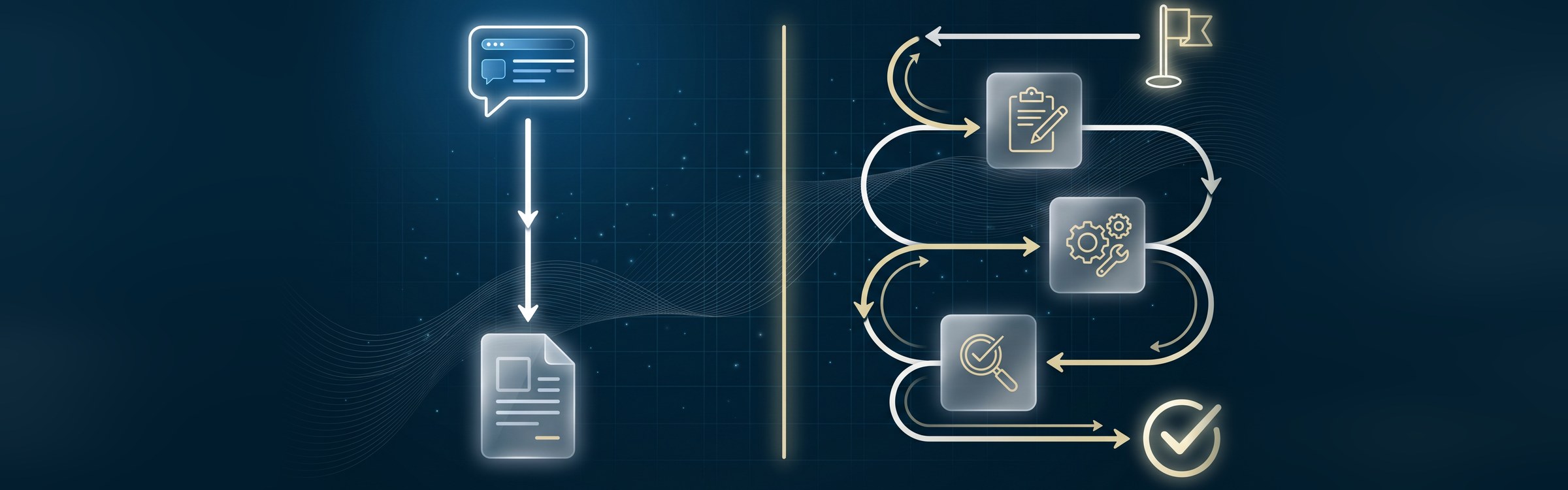
Generative AI creates content, such as text, images, or code, in response to a prompt. Agentic AI goes a step further: it plans and takes actions on its own to reach a goal, often using generative AI as one of its tools. In short, generative AI answers and creates, while agentic AI decides and does.
Both terms are everywhere right now, and they’re often used as if they mean the same thing. They don’t, and the difference matters when you’re deciding where AI fits in your business. One helps your people work faster. The other can take work off their plate entirely, but needs more setup and more guardrails.
Below, we explain each one in plain language, compare them side by side, show real business examples, and cover how to choose the right approach.
What Is Generative AI?
Generative AI is a type of artificial intelligence that produces new content based on patterns it learned from large amounts of data. You give it a prompt, and it generates a response.
Common examples include ChatGPT, Google Gemini, and Claude for text, Midjourney for images, and GitHub Copilot for code. Businesses use generative AI to draft emails, summarize documents, write product descriptions, create first drafts of reports, and answer questions from internal knowledge.
The key point is that generative AI is reactive. It waits for a prompt, produces an output, and stops. A person still decides what to do with that output.
What Is Agentic AI?
Agentic AI refers to AI systems that can work toward a goal with a degree of independence. Instead of producing a single response, an agentic system breaks a goal into steps, decides which tools to use, takes action, checks the results, and adjusts until the task is done.
For example, you might ask an agentic system to “follow up with every lead from last week’s webinar.” It could pull the attendee list from your CRM, check who has already been contacted, draft personalized emails, send them, and log each one back in the CRM.
The key point is that agentic AI is proactive. It doesn’t just suggest what to do. It does it, within the limits and permissions you set.
Agentic AI vs Generative AI: Key Differences
| Generative AI | Agentic AI | |
|---|---|---|
| Main purpose | Create content | Complete goals and tasks |
| How it starts | Responds to a prompt | Works from a goal or trigger |
| Level of independence | Low: one response per prompt | Higher: plans and acts across many steps |
| Takes actions? | No, a person acts on the output | Yes, through connected tools and systems |
| Uses other tools? | Rarely | Yes: CRMs, databases, APIs, email, calendars |
| Memory and context | Mostly within one conversation | Keeps track of progress across a task |
| Typical output | Text, images, code, summaries | Completed work: updated records, sent messages, resolved requests |
| Main risk | Inaccurate or made-up content | Wrong actions taken on real systems |
| Human role | Reviews and uses the output | Sets goals, rules, and approvals; monitors results |
An easy way to remember it: generative AI is a talented writer you brief one request at a time. Agentic AI is a team member you give a goal to, along with access to the tools they need.
How Agentic AI and Generative AI Work Together
Agentic AI doesn’t replace generative AI. In most systems, it uses it. A typical agent relies on a large language model to understand requests and write responses, then adds the pieces generative AI lacks:
- Planning: Breaking a goal into steps and deciding the order.
- Tool use: Calling APIs, querying databases, or running workflows in other systems. Our guide to API integration explains how these connections work.
- Memory: Keeping track of what’s been done and what’s left.
- Feedback loops: Checking results and trying a different approach if something fails.
- Guardrails: Rules about what the agent can access, change, or must hand off to a person.
So the difference isn’t really “one or the other.” Generative AI is a capability. Agentic AI is a system built around that capability so it can act.
Agentic AI vs AI Agents: Are They the Same?
Not quite. An AI agent is a single piece of software built to handle a specific job, like answering support tickets or qualifying leads. Agentic AI is the broader approach or capability: AI that can act autonomously. A large agentic system may coordinate several AI agents, each with its own role, working together toward a bigger goal.
Salesforce’s Agentforce is a good real-world example of AI agents in a business platform. Our post on what is Agentforce explains how those agents are built and controlled.
Agentic AI vs Generative AI Examples
Here’s how the same business need looks with each approach:
- Customer support: Generative AI drafts a reply for an agent to send. Agentic AI reads the request, checks the order, processes the refund, and closes the ticket.
- Sales: Generative AI writes a follow-up email template. Agentic AI identifies which leads need follow-up, personalizes and sends each email, and updates the CRM.
- Finance: Generative AI summarizes a stack of invoices. Agentic AI matches invoices to purchase orders, flags mismatches, and routes them for approval.
- IT support: Generative AI explains how to reset a password. Agentic AI verifies the user, resets the password, and logs the request.
- Marketing: Generative AI writes ad copy variations. Agentic AI launches the variations, monitors performance, and shifts budget toward what’s working.
What About Predictive AI?
Predictive AI is a third category you’ll often see alongside these two. It analyzes past data to forecast what’s likely to happen, such as which customers might cancel, how much stock you’ll need, or which leads are most likely to buy. Predictive AI forecasts, generative AI creates, and agentic AI acts. Many modern systems combine all three.
Risks and Challenges of Agentic AI

Because agentic AI takes real actions, the stakes are higher than with content generation. Key challenges include:
- Wrong actions: A mistake doesn’t just produce a bad paragraph. It can update the wrong record or send the wrong message.
- Data quality: Agents make decisions based on your data. Messy, duplicated, or disconnected data leads to poor decisions. Our guide to CRM vs ERP covers why connected systems matter.
- Security and access: Agents need permissions to act, so those permissions must be tightly scoped and monitored.
- Unapproved tools: Teams experimenting with AI agents outside IT’s view create new risks. This is a growing form of shadow IT and shadow AI.
- Messy systems: Agents struggle in environments full of outdated workflows and workarounds. Cleaning up technical debt makes agents easier to build and safer to run.
The good news is that these risks are manageable with clear goals, limited permissions, human approval for high-impact actions, and regular monitoring.
Which Should Your Business Use?
Most businesses benefit from starting with generative AI and moving toward agentic AI for the right tasks.
- Start with generative AI if you want quick wins in writing, summarizing, research, and internal knowledge search, with a person reviewing every output.
- Move to agentic AI for high-volume, repeatable, rules-based tasks where the steps are clear and the systems involved are connected, such as order updates, lead follow-up, or ticket routing.
- Keep people involved for decisions with financial, legal, or customer-relationship impact.
Choosing where AI fits is easier when it’s part of a wider plan. Our guide on how to build a digital transformation strategy walks through how to prioritize initiatives like this.
Frequently Asked Questions
What is the main difference between agentic AI and generative AI?
Is ChatGPT generative AI or agentic AI?
Is agentic AI better than generative AI?
What is the difference between agentic AI and AI agents?
What are examples of agentic AI?
Putting the Right AI to Work
The agentic AI vs generative AI question comes down to this: generative AI helps your people create faster, and agentic AI helps your business get work done with less manual effort. The right mix depends on your goals, your data, and how well your systems are connected.
At BitWaves, we help businesses across Canada and the US identify practical AI use cases, connect the systems AI depends on, and put the right guardrails in place. Explore our digital transformation services, or get in touch to talk about where AI can make a real difference for your team.